Drive, Fly, or Take the Train?
The fastest way to reach a destination is not always the best way to begin a trip.
By Christopher Cockrum, Éto Travel Advisor

The fastest trip is not always the shortest
Travel planning often begins with a deceptively simple question: how quickly can I get there?
A three-hour flight appears to beat an eight-hour drive. A ninety-minute flight seems unquestionably better than five hours on the road. But scheduled travel time tells only part of the story.
Flying includes getting to the airport, parking or arranging transportation, arriving early, security, boarding, possible delays, baggage claim, and then traveling from the destination airport into the city.
Driving has its own costs. Traffic, fuel stops, fatigue, parking, and long stretches behind the wheel can consume both time and energy.
Rail introduces another calculation. A train may take longer than a flight while allowing you to arrive closer to the center of your destination, avoid airport procedures, move around during the journey, and actually use some of the travel time.
The best transportation choice is therefore not necessarily the one with the smallest number beside it.
Count the whole journey
Instead of comparing flight time with driving time, compare door-to-door time.
Imagine a flight scheduled for two hours. You leave home an hour before you need to reach the airport. You arrive ninety minutes before departure. The flight takes two hours. After landing, another forty-five minutes passes between leaving the aircraft, collecting luggage, and reaching ground transportation. Then you spend forty minutes traveling into the city.
That two-hour flight has quietly become a journey of more than six hours.
If the same destination is six hours away by car, the comparison suddenly looks very different.
This matters especially for short trips. Losing several hours to transportation on a week-long vacation may be insignificant. Losing them during a 48-hour escape can fundamentally change the trip.
When driving wins
Driving is particularly powerful for regional travel because it offers something airlines rarely can: control.
You choose when to leave. You can change the route. You can stop somewhere interesting along the way. You can bring more luggage without worrying about baggage rules. Once you arrive, you already have transportation.
For destinations roughly three to six hours away, driving can often compete surprisingly well with flying once the entire airport process is considered.
Driving becomes even more attractive when the destination itself is spread out. National parks, small towns, wine regions, mountain areas, coastal routes, and rural destinations often require a car after arrival anyway.
There is also a less measurable advantage. Sometimes the road is part of the journey.
A good roadside restaurant, an unexpected overlook, a small museum, or a town you had never planned to visit can become one of the memories that defines the trip.
When flying wins
Flying becomes increasingly valuable as distance grows.
When driving would consume most of a day, a flight can preserve the time that actually matters: the hours spent at the destination.
This is particularly important for short trips to distant cities. A weekend in New York, Chicago, Denver, Los Angeles, or another major metropolitan destination may only be practical because air travel compresses hundreds or thousands of miles into a few hours.
Flying also makes sense when transportation at the destination is easy. A city with strong public transit, walkable neighborhoods, or inexpensive local transportation reduces the need to bring a car.
But airfare alone should never make the decision. Airport location, flight schedules, connections, baggage costs, parking, ground transportation, and the likelihood of delays all belong in the calculation.
When rail wins
Rail occupies an interesting middle ground between driving and flying.
It rarely offers the complete freedom of a car or the raw speed of a plane, but on the right route it can offer something better than either: useful travel time.
You can read, work, talk, eat, watch the landscape, or simply rest while the train continues moving toward the destination.
Rail stations are also frequently located closer to city centers than airports. That can eliminate a significant amount of ground transportation at both ends of the journey.
The strongest rail routes can make two downtown districts feel remarkably close to one another.
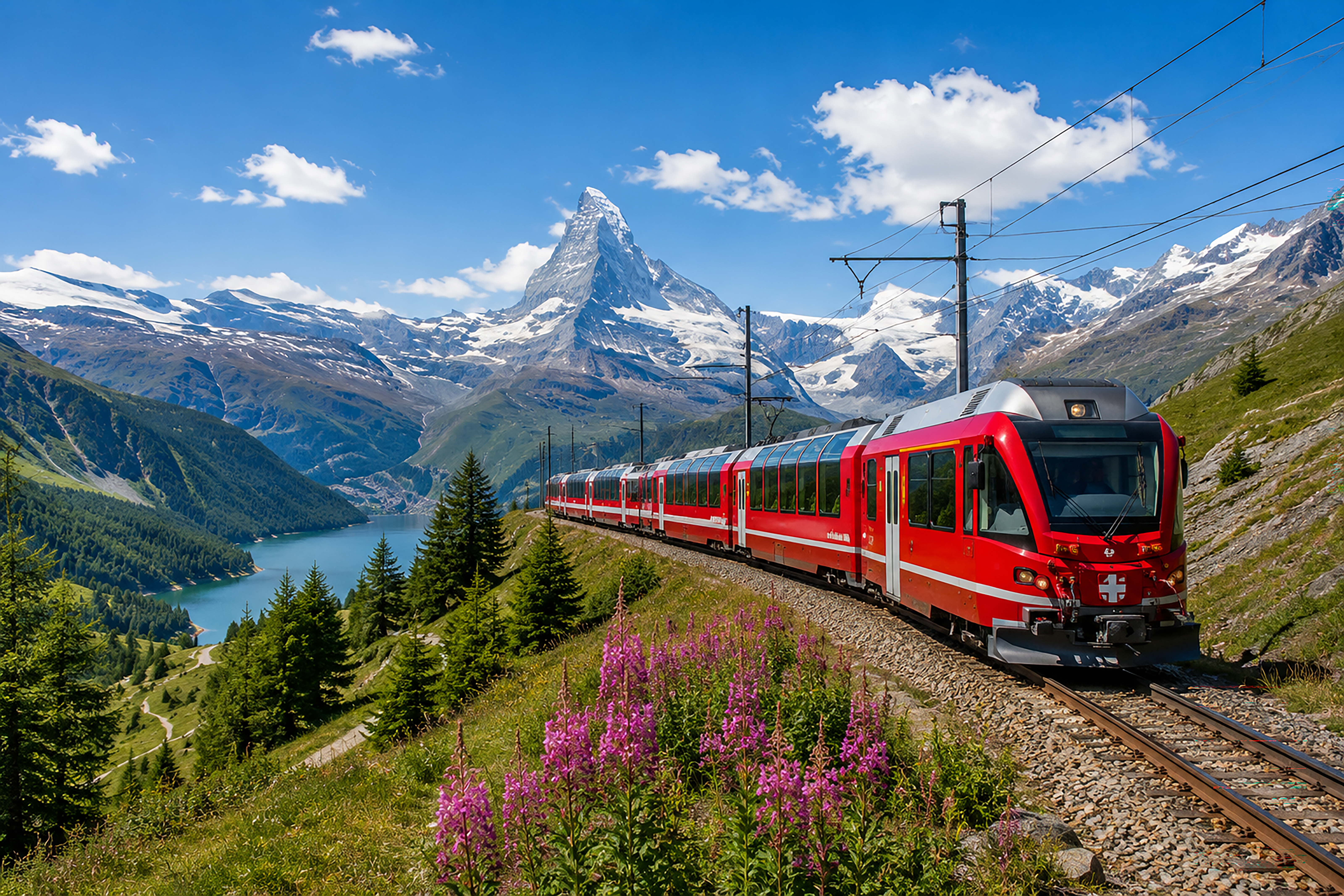
Rail becomes especially compelling when the journey itself is scenic. In those cases transportation stops being an inconvenience between experiences and becomes one of the experiences.
The hidden cost of airport time
Airports introduce friction that is easy to underestimate because much of it does not appear on the ticket.
There is the journey to the airport. The buffer before departure. Security. Boarding. Taxiing. Deplaning. Baggage claim. Rental car counters. Ground transportation.
None of these steps is necessarily difficult, but together they create what might be called travel overhead.
For a long journey, that overhead is usually worth paying because the aircraft eliminates an enormous amount of distance.
For a short journey, the overhead can become larger than the advantage.
This is one reason a five-hour drive can sometimes feel easier than a ninety-minute flight.
The value of arriving in the city center
Where transportation leaves you matters almost as much as how quickly it gets you there.
Airports are often located well outside the neighborhoods travelers actually want to explore.
Rail stations, by contrast, frequently sit inside or near the urban core. In some destinations you can step off the train and begin the trip almost immediately.
That changes the mathematics of a short journey.
Thirty minutes saved here and forty-five minutes saved there may not sound significant individually. Across a 48-hour trip, those fragments can become an additional museum, dinner, neighborhood walk, or unhurried morning.
Sometimes the road trip is the destination
Transportation should not always be treated as something to minimize.
There are journeys where driving is part of the reason to go.
A coastal highway, mountain pass, desert road, historic route, or string of small towns can transform the space between two destinations into the central experience.
In these cases efficiency becomes a different concept.
Taking longer is not necessarily inefficient if those additional hours contain experiences you actually wanted.
The important distinction is between time that enriches the journey and time that merely consumes it.
Let the length of the trip change the answer
Transportation choices should become more demanding as trips become shorter.
On a ten-day vacation, spending half a day getting somewhere may be completely reasonable.
On a three-day trip, that same half day represents a substantial portion of the experience.
On a 48-hour escape, every hour becomes valuable.
This does not mean short trips must always stay close to home. It means transportation should earn the time it consumes.
A short flight to an extraordinary destination may easily justify the airport process. An exhausting connection to a destination only marginally more interesting than somewhere nearby may not.
Budget changes the calculation too
Transportation is not only a question of time. It is also a question of what else the transportation cost prevents you from doing.
A cheaper drive might leave enough room in the budget for a remarkable hotel or memorable dinner.
An inexpensive flight might make a distant destination surprisingly practical.
Rail may eliminate parking fees, rental cars, or airport transfers.
The useful question is not simply which ticket costs less.
Ask what the entire transportation choice costs and what that choice allows the rest of the trip to become.
A simple Éto decision framework
When comparing transportation options, begin with four things: total door-to-door time, total cost, effort, and useful destination time.
First, estimate how long each option actually takes from leaving home to reaching the place where the trip begins.
Second, include the full cost. Think about fuel, parking, airfare, baggage, rental cars, train tickets, airport transfers, and local transportation.
Third, consider effort. Six hours relaxing on a train is not necessarily equivalent to six hours driving through traffic.
Finally, ask how much meaningful time remains once you arrive.
That last number is often the most revealing.
When either is the smartest answer
Sometimes there is no obvious winner.
A destination may be close enough to drive but far enough that flying is attractive. Rail may be slower but substantially more relaxing. Prices may shift enough that the best answer changes from one weekend to another.
In those situations, flexibility is an advantage.
Instead of deciding the transportation mode first and forcing the destination around it, compare the complete journeys.
This is especially useful when discovering spontaneous trips. A remarkable airfare, a beautiful rail route, or an unexpectedly manageable drive can each reveal destinations you might otherwise overlook.
The transportation mode becomes another part of destination discovery rather than merely a logistical decision.
Choose the journey, not just the vehicle
Travel does not begin when you arrive.
It begins when you leave home.
That means the hours spent driving, flying, riding a train, waiting, transferring, and navigating are part of the experience whether we acknowledge them or not.
A thoughtful traveler does not simply choose the fastest transportation.
They choose the transportation that makes the whole journey better.
Choose the mode that preserves the most useful destination time at a cost and effort level that still makes the trip worth taking.
Éto Express
You have the weekend.
Where should you go?
Tell Éto where you are starting, how much time you have, what you want to spend, and what makes a trip worthwhile to you.
Find My Best EscapeContinue the Idea
Take the story into the world.
Explore a curated journey that puts this travel strategy into practice.